

A Brief History of the Gregorian Calendar
What are the Julian and Gregorian Calendars?
Why are ‘months’ a bit longer when the full moon occurs every 29.5 days?
Why do we have a leap year every 4 years?
Why is December, named for the 10th month when it is the 12th month?
Why does the Financial Year start on 6th April?
Why is Christmas on the 25th of December?
Why does the date for Easter keep changing every year?
Why do we have chocolate eggs at Easter (bunnies in the USA)?
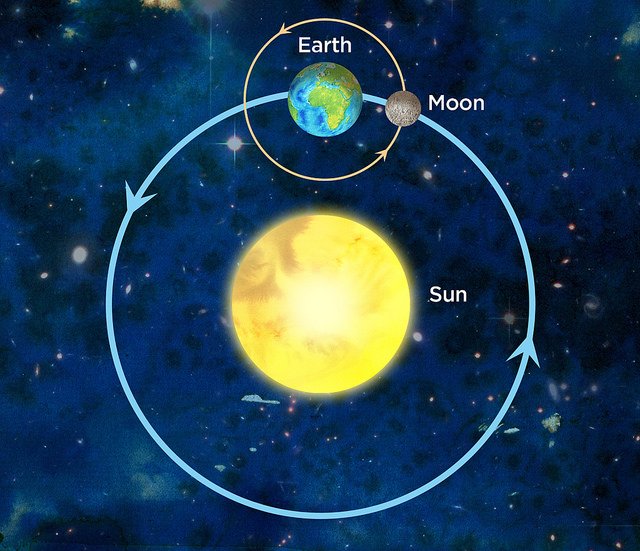 The big problem is how could mankind create a calendar of whole numbers of months and days for a year when the following two facts are what we have to deal with?
- The Earth takes approximately 365.2564 days to complete one full orbit around the Sun. That is, one year is equal to approximately 365 days, 6 hours, 9 minutes and about 10 seconds.
- The Moon averages 29.53 days, specifically 29 days, 12 hours, 44 minutes, and about 3 seconds, a synodic month, to cycle from new moon to new moon as it orbits the Earth. So 12 equal months just does not work.
Since the dawn of our species in Equatorial Africa, we have looked to the phases of the Moon, probably so we knew when best to move around at night. These ‘months’ of about 29.5 days were given names to relate to the weather, such as regular floods or droughts and events like the annual meeting of the tribes to exchange women, just as native people of tropical regions still do today. When ‘modern’ humans migrated out of Africa some 100,000 or more years ago, and more recently going further and further north, the changing seasons and length of daylight caused by the tilt of the Earth as it orbited the Sun would also become significant. It would tell us when the migrating herds would arrive and when to plant and harvest our crops. The new year for most people started around the Spring Equinox until only a few hundred years ago, and strangely still does for income tax and other financial purposes.
Various attempts to formalise a calendar, dating as far back as 6,000 years ago, have been found in Egypt and the Middle East. For some unknown reason around 2,750 years ago, the Romans created a calendar for the year that was divided into only 10 lunar months. They named the months (and the planets) after their gods. The year started with what we now call March (after Mars the god of war) and when they run out of gods, they numbered them, and we still have September, October, November, and December. Around 713 BC, two more months, January and February were added ‘after’ December to make 12 lunar months of alternating 29/30 days that more exactly followed the observed phases of the moon. This totalled only 354 days so was followed by an 11 day ‘dead’ winter period to make a full calendar year of 365 days.
When Julius Caesar conquered Egypt and the Middle East he decided to copy them and bring the calendar back into line with the correct length of the year. In 45 BC he gave the 12 months an alternating 30/31 days, almost like we have now, to total the 365 days of the solar year. He also added an extra day to February every 4 years (“Leap Year”) because the Earth was observed to take another quarter of a day to orbit the Sun. It is a little more than that, but they did not have complex fractions then and thought it was close enough. He also instructed the New Year to start on 1st January, nearer to the Winter Solstice (then the 25th of December), but that was largely ignored by the starving masses who had no need for a calendar anyway. After his death, the 5th month, Quintilis was rebranded as Julius (July), to celebrate the month in which he was born. Later, the 6th month, Sextilis, was renamed August in honour of the later Emperor Augustus. But August was only 30 days and July 31, so a day had to be lifted out of February to make things equal.
In most countries and until quite recently, the New Year started around the Spring Equinox (then the 25th of March) when new crops were planted. It was a time also celebrated, by the northern barbarian hoards who later destroyed the Roman Empire, for Eostre, the goddess of fertility, dawn, and light. Rabbits would be courting in the fields and birds laying eggs, hence the Easter Bunny and Easter Eggs. Also, the Winter Solstice (then the 25th of December) was a celebration of the days starting to get longer following the long cold nights of winter. Either was considered as the start of a new year in the northern hemisphere.
When the Roman Catholic Church later took over Europe, the day set for the celebration of the Resurrection of Jesus took over the pagan cosmic-based festival of Easter. But they really liked to confuse themselves and everyone else, with the result that Easter occurred on different days in different countries for many centuries to come. This is because in 325 AD it was decided that Easter would be on the first Sunday, following the first full moon, after the spring equinox (then 25th March). But then it had to be a week later if that date coincided with the fixed date of the Jewish Passover. They also decided to overwhelm the recently converted pagans and celebrate Christmas on the day of the Winter Solstice (then the 25th of December). The “Star of Bethlehem”, probably a comet, and other historical evidence now known today, suggests that the actual birthday for Jesus must have been sometime around April, and in 5 BC.
Problem – adding a whole day every 4 years for a ‘leap year’ is about 36 minutes too much. This didn’t seem important to Julius Caesar in 45 BC, nor easily measured. However, it does add up and was creating a calendar slip of an increasing number of days over the following centuries.
So, by 1582 AD, the two annual equinoxes and solstices now actually fell on the 11th not 25th of their months, so if nothing was done Easter would eventually end up back-dated to Christmas. After many centuries of persuasion by many learned people, the then Pope Gregory XIII (of a church believing until 1822 that God made the Sun to orbit the Earth at the centre of the universe), finally agreed to drop 10 days by simply pushing the then ‘Julian’ calendar forward by 10 days (4th October that year was followed by 15th October ). It needed to be 14 days, but it had been decided that the Christian festivals should be kept separate from the cosmic or pagan (non-Christian) events, so just the 10 days would push the latter to around the 21st of their months, where they would remain.
However, back in 1534, the then King Henry VIII had thrown out the Roman Catholic Church with its over-ruling authority by their Pope. So, the new ‘Gregorian’ calendar was ignored by Britain and its budding empire, which eventually covered about a quarter of the Earth’s total land area.
But in 1752 and with the start of the Industrial Revolution, Britain finally gave in and aligned its calendar with most of the rest of Europe. By now there were 11 not 10 days needing to be dropped. Also, the calendar had become a far bigger part of everyday life than it would have been in 1582 with all the new commerce and trade classes and the farmers with debts to pay at the end of the year. So, people woke up one morning in September that year and the calendar said it was 11 days later. Suddenly the end of the year, then on 25th March, was 11 days closer for taxes, debts, and interests to be paid. There were riots. They wanted their 11 days back. So just for them, their new year got pushed forward by 11 days to make the ‘Financial Year’ now end on the 5th of April, and there it has remained. But for everything else the ‘New Year’ was now officially moved to 1st January, almost 1800 years after Julius Caesar had declared it so in 45 BC.
Finally, to help prevent this calendar slip of about 36 minutes every 4 years, 15 hours per century, continuing into the future, it was decided to drop the added day for the leap year on the turn of every 3 out of 4 centuries. That is, no leap year if the year is not divisible by 400. So, 2000 was a leap year as will be 2400 but 2100, 2200 and 2300 will not be. This still does not make things perfectly correct but modern, accurate timekeeping now allows the occasional “leap seconds” to be sneaked in and keep things in perfect sync with the Earth’s rotation.
Some countries like Greece (in 1923) and Turkey (in 1926) held out against all this even longer than Britain. The Gregorian calendar is now the international standard for civil, business, and legal purposes throughout most of the world. The few exceptions are Ethiopia, Nepal, Iran, and Afghanistan. Several countries still use their own ancient systems alongside the Gregorian.
Months of the Year:
Modern English – Roman (Latin) Name
March – Martius – named after Mars, the god of war.
April – Aprilis – from aperire, Latin for ‘to open’ (buds).
May – Maius – named after Maia, the goddess of growth of plants.
June – Junius – named after the goddess Juno.
July – Quintilis/Julius – from quintus, the fifth month, renamed after Julius Caesar in 44 BC.
August – Sextilis/Augustus – from sextus, the sixth month, renamed after Augustus Caesar in 8 BC.
September – September – from septem, Latin for seven.
October – October – from octo, Latin for eight.
November – November – from novem, Latin for nine.
December – December – from decem, Latin for ten (as in decimal).
January – Januarius – named after Janus, the god of doors and gates.
February – Februarius – named after Februum, the time for religious rites of purification.
Days of the Week:
Modern English – Anglo-Saxon, Dane and Norse (‘æg’ is sounded like ‘eye’)
Sunday – Sunnandæg – for day of the sun.
Monday – Monandæg – for the moon’s day.
Tuesday – Tiwesdæg – for Tiw, Tiu or Týr, the one-handed god of war and the sky.
Wednesday – Wodnesdæg – for Woden or Odin, the supreme god.
Thursday – Thuresdæg – for Thunor or Thor, the god of thunder.
Friday – Frigedæg – for Frigga or Freyja (same sound), the goddess of love, and wife of Odin.
Saturday – Sæternesdæg – for Saturni’s day, the father of Roman gods and god of agriculture.
The Scandinavian and Germanic countries use similar day names derived from the above same roots as Britain. Whereas Spain, France and Italy spent more time under Roman influence and derived both their day and month names from Latin, the language of the Roman nobility.